
The useful question is not whether personal trainers are always worth the money. It is which kind of support you need for the next stage of your training. Coaching, an app, and training without a tool solve different problems, and many people use a combination of all three over time.
When a personal trainer helps most
Paying for coaching makes the most sense when observation and immediate feedback are the missing pieces. That is often the case when you are:
- new to resistance training or unfamiliar with an exercise;
- unsure whether your technique is repeatable under effort;
- working toward a specific goal that needs an individual plan;
- struggling to train consistently without an appointment;
- returning after an injury once an appropriately qualified health professional has cleared you to train.
Current pain, a suspected injury, or a medical concern is a healthcare question first. A general fitness trainer should not diagnose or rehabilitate it unless they hold the appropriate additional qualification.
A trainer can see a repetition from angles you cannot, adjust the exercise while you are doing it, and explain why the plan changes. A video or exercise library can demonstrate a movement, but it cannot tell whether your version matches the demonstration.
What the injury research actually says
Strength training is not a countdown to an inevitable injury. A systematic review of competitive weight-training sports found generally lower injury rates than common team sports. It also reported the shoulder, lower back, and knee among the more commonly injured areas. Most included studies were retrospective, so those findings describe patterns in competitive lifting; they do not predict an ordinary gym-goer's personal risk.
One prospective study followed 168 newcomers through an eight-week CrossFit start-up program. Twenty-five participants reported a new injury, an incidence of 14.9% in that specific setting. That number should not be turned into a universal "one in seven beginners" rule: the study covered one form of high-intensity group training over a short period, and more than half of participants reported pain or soreness before the program began.
A separate survey of 386 CrossFit participants found that greater trainer involvement correlated with a lower reported injury rate. Because it was a self-reported survey, it cannot prove that supervision alone prevented injuries. It does support a narrower conclusion: live feedback can be valuable, especially while learning unfamiliar movements.
Technique is only one part of injury risk. Exercise selection, load, fatigue, previous injuries, recovery, and individual health also matter. An app cannot diagnose pain, and a general fitness trainer is not automatically qualified to treat an injury.
Trainer vs app vs training alone
| Option | Best fit | What it does well | Main limitation |
|---|---|---|---|
| Personal trainer | Beginners, new movements, specific goals, accountability | Live observation, immediate cues, individual adjustments | Cost, scheduling, and variable coaching quality |
| Workout tracker | People who know what to do but want structure and records | Routines, instructions, logging, timers, and progress history | Cannot watch your movement, assess pain, or replace clinical care |
| Training alone | Experienced, self-directed trainees with a suitable plan | Maximum flexibility and no coaching or software cost | You supply the planning, feedback, records, and accountability |
These are not mutually exclusive. A practical combination is to learn unfamiliar movements with a qualified trainer, use an app to execute and record the plan, and book another technique check when the program or exercises change.
One small 10-week randomized trial of trained adults reported different adherence levels across supervised, app-guided, and PDF-only groups. The share who completed at least 85% of prescribed sessions was 88.2% with in-person supervision, 81.2% with app-guided training, and 52.2% with a PDF plan. The sample was small, and the study's app included exercise videos and delayed technique feedback that not every workout tracker has. This is useful context rather than a promise about individual results or SetGrip specifically.
How to choose a trainer
Start with competence, not appearance. Qualification rules differ by country, so look for a current, reputable credential recognized where you live, plus relevant experience with your goal. If you have pain, an injury, or a medical condition, ask whether the person is actually qualified for that situation and whether they refer clients to a clinician when a case is outside their scope.
During an introductory session, look for behavior you can observe:
- they ask about your history, goals, constraints, and current plan;
- they explain the reason for an exercise and how it will progress;
- they watch the set and give specific, understandable feedback;
- they adjust the session instead of treating pain as something to ignore;
- they are clear about pricing, cancellations, and what success means.
Be cautious with guaranteed outcomes, unexplained "secret" methods, pressure to buy supplements, or heavy loading before the trainer understands your starting point. There is no universal number of sessions that everyone needs. Agree on a short review point, then decide whether you still need live feedback or can continue independently.
When you can train on your own
You are in a stronger position to train independently when you can:
- set up and repeat your exercises with control;
- follow a plan that matches your current goal and experience;
- progress load or volume without guessing every session;
- recognize when an exercise needs to be adjusted or stopped;
- keep enough records to see what is actually changing;
- train consistently without relying on an appointment.
If one of those pieces is missing, you do not necessarily need permanent one-to-one coaching. You may need one technique session, a better program, a tracking system, or a qualified health professional — depending on the actual problem.
How SetGrip fits into a real workout
Imagine that a trainer has helped you choose a suitable routine and learn its unfamiliar movements. SetGrip can support what happens between coaching sessions:
- Build the routine. Add the exercises, targets, and rest times you intend to follow.
- Run the session. See the weight and reps from your previous workout beside each set, log the current set, and use the rest timer instead of watching the clock.
- Review the result. Use the workout summary, records, progress charts, and plateau alerts to see what changed.
- Know the boundary. If you are unsure about a movement or have pain, take that question back to an appropriately qualified person; the app does not assess technique or pain.
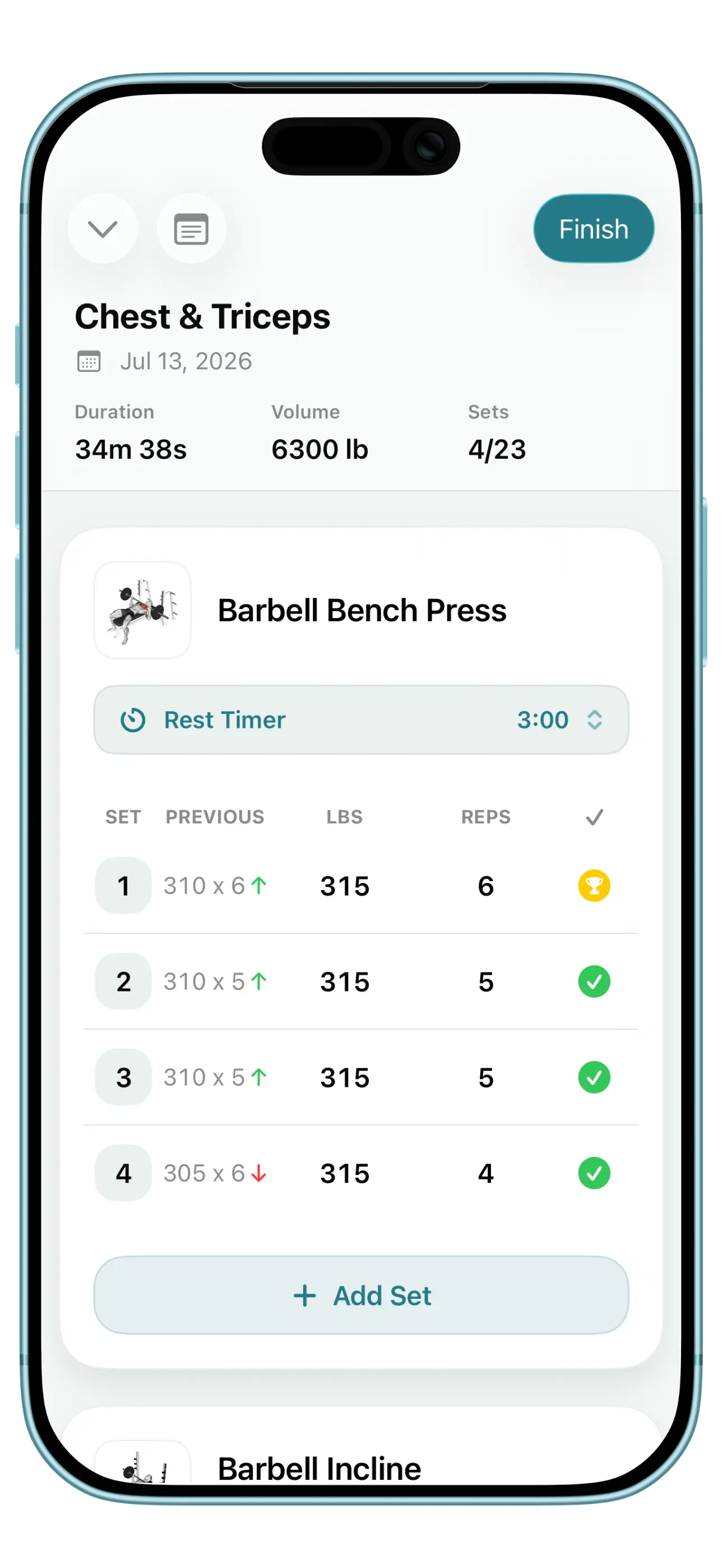
You can see how SetGrip works on the homepage, including its exercise library, workout logging, Apple Watch companion, and progress tools. It is a tracking tool, not a substitute for coaching or healthcare.
The practical answer
Hire a qualified trainer when you need eyes on your movement, individual decisions, or an appointment that gets you through the door. Use a workout tracker when the plan is suitable but execution, records, and consistency need more structure. Train without either when you can provide those things yourself. The right choice can change as your experience, exercises, and goals change.