Short answer: in a 2024 study from Finland (Halonen et al.), beginners who trained for 10 weeks and then stopped for 10 weeks lost about 5% of their leg press strength. They had it back within 5 weeks of training again.
Leg press strength before and after a 10-week break
Average one-rep max (the most weight lifted once), in kg, of the 20 beginners who took the break in the 2024 Finnish study
Shorter breaks cost less. A 2013 review of elite rugby and American football players found that strength held up for up to 3 weeks without training (McMaster et al.).
Other studies found bigger losses. After 9 weeks of training and 31 weeks off, adults aged 20 to 30 had lost 8% of their strength and adults aged 65 to 75 had lost 14% (Lemmer et al., 2000). The elite players in the 2013 review lost 14.5% on average across breaks that averaged about 7 weeks.
The studies below followed adults through planned breaks of 1 to 32 weeks. The authors of the 2024 Finnish study write that their results “cannot be directly applied to situations where training breaks are caused by illnesses or injuries”. We would add surgery and pregnancy: if one of those is behind your break, ask the doctor, physical therapist or midwife who cares for you.
Do you lose strength after a week or two off?
In the studies we read, breaks of up to 3 weeks cost little or no strength. The studies below used breaks of 1 week and 3 weeks, so we have no figure for exactly 2 weeks.
A 2013 review (McMaster et al.) covered 27 studies of elite rugby and American football players. It concluded that strength can be maintained for up to 3 weeks without training, and that losses speed up after that.
In a 2013 study of 14 young men (Ogasawara et al.), one group trained the bench press 3 days a week for 24 weeks without stopping. The other group stopped for 3 weeks, twice, inside the same 24 weeks. Both groups finished with similar gains in strength and muscle size.
Even one week off may slow your progress a little. In a 2024 study (Coleman et al.), 39 adults who had lifted for at least a year followed a 9-week program. One group took a week off in the middle, and the other kept training. Both groups finished stronger than they started. The group that kept training gained more. Their squat one-rep max (1RM), the most weight they could lift once, rose by about 16 kg. In the group that took the week off, the figure was 13 kg. The authors called that a modest benefit, and their statistics left open the chance that there was no real difference. A second strength test, done without movement, pointed the same way. Muscle growth was about the same in both groups.
How much strength do you lose after a month or more?
Past the first few weeks, strength does drop: by about 5% after 10 weeks off in one study of beginners and, in a study of two age groups, by 8% and 14% after 31 weeks off. A 2013 analysis that combined 103 studies (Bosquet et al.) found that the loss grew with the length of the break.
We have no figure for exactly one month. Among the studies we read, the nearest breaks studied on their own are 3 weeks and 10 weeks. The review of elite players gives only an average, across breaks of about 7 weeks.
In the studies here with a single break of 10 weeks or more, the training before the break lasted only 9 to 20 weeks. The only figures for athletes come from the review of elite players.
Strength lost during a break, in four groups
Average loss, in order of the length of the break
The 10-week figure comes from a 2024 study at the University of Jyväskylä in Finland (Halonen et al.). Its participants were healthy adults, 32 years old on average, who had not lifted regularly before. Twenty of them trained twice a week for 10 weeks, stopped for 10 weeks, then trained for 10 more. After the 10 weeks off, their leg press 1RM was down 5.4% and their biceps curl 1RM was down 3.6%. The authors write that the results may not apply directly to other exercises, and that more research is needed on people who have trained for longer.
In a 2000 study (Lemmer et al.), a group aged 20 to 30 and a group aged 65 to 75 held their strength equally well through the first 12 weeks without training. Most of the loss came after that, and by week 31 the older group had lost more: 14% against 8%. The 2013 analysis of 103 studies also found bigger losses in people over 65.
| Break | Who was studied | What happened to strength |
|---|---|---|
| 1 week (Coleman et al., 2024) | 39 adults who had lifted for at least a year. 18 of them took a week off in the middle of a 9-week program | Both groups got stronger. The group that took the week off gained less |
| 3 weeks, twice (Ogasawara et al., 2013) | 14 young men who trained the bench press for 24 weeks | Similar gains to the group that trained without a break |
| About 7 weeks on average (McMaster et al., 2013) | Elite rugby and American football players, in a review of 27 studies | Down 14.5% on average across all the breaks in the review, which averaged 7.2 weeks. Maintained for up to 3 weeks |
| 10 weeks (Halonen et al., 2024) | 20 beginners who had trained for 10 weeks | Leg press 1RM down 5.4%, biceps curl 1RM down 3.6%. Back to the pre-break level within 5 weeks |
| 20 weeks (Psilander et al., 2019) | 19 adults who had trained one leg for 10 weeks | Still above where it was before the training. The muscle was back to its size before the training |
| 31 weeks (Lemmer et al., 2000) | 18 adults aged 20 to 30 and 23 adults aged 65 to 75, after 9 weeks of training | 1RM down 8% in the younger group and 14% in the older group |
| 30 to 32 weeks (Staron et al., 1991) | 6 women who had trained for 20 weeks | Fell, but stayed above where it was before they first trained |
What if you can still train a little?
A 2021 review (Spiering et al.) concluded that younger adults can maintain strength and muscle size for up to 32 weeks with as little as 1 strength session a week and 1 set per exercise. The condition is that the weights stay as heavy as before. Older adults may need up to 2 sessions a week and 2 to 3 sets per exercise to keep their muscle size.
The summary of the 2021 review gives no ages for its younger and older groups. The review covers the general population, and its authors found too little data to say the same for athletes.
How long does it take to get strength back?
In the Finnish study of beginners (Halonen et al., 2024), 5 weeks of training brought back what 10 weeks off had taken away. That was true of leg press strength, biceps curl strength and muscle size. After 10 weeks of training, all three were above their pre-break levels.
The group’s average leg press 1RM was 197.6 kg before the break, 187.5 kg after it and 201.5 kg after 5 weeks of training again (Figure 1).
The researchers tested strength only every fifth week, so the study cannot say whether it was back sooner. The loss was also small to begin with. After the break, the group was about as strong as it had been 5 weeks after it first started training.
A second group in the same study trained for 20 weeks without a break. By the end of the study, both groups had made similar gains. The authors wrote this about recreational lifters (RT is their short form for resistance training):
“… our results suggest that recreational RT practitioners should not be too concerned about an occasional 10-week training break, for example, once a year, as long as the RT performed is effective and regular.”
Halonen et al., 2024
The Finnish study’s 5 weeks is the only return time in the studies we read. None of them gives a formula for breaks of other lengths, and the longest break in Table 1 was 32 weeks.
Is muscle memory real?
Muscle memory is the idea that a muscle responds better to training if it has been trained before. Whether that is true is still an open question.
In a 2019 study (Psilander et al.), 19 adults trained one leg for 10 weeks and then stopped for 20 weeks. By the end of the 20 weeks off, the muscle had shrunk back to its size before the training. Strength was still above where it was before the training. The authors linked that to a “long-lasting motor learning effect”. Motor learning is the skill side of strength: how well your body has learned the movement.
In the Finnish study, too, muscle size fell more than strength. Ten weeks off reduced the size of a thigh muscle by 9.9% and the biceps by 7.3%, roughly twice the loss in strength. The difference was statistically clear for the legs and less certain for the arms.
Muscle size fell more than strength during 10 weeks off
Average loss in the group that took the break, 2024 Finnish study
A popular explanation for muscle memory is about nuclei, the control centers of a cell. The idea is that training adds nuclei to muscle fibers and that the nuclei stay when the muscle shrinks. In a 2024 study (Cumming et al.), 12 adults trained one arm for 10 weeks and then stopped for 16 weeks. The extra nuclei were still there. But when both arms were then trained for 10 weeks, the arm that had trained before did not clearly grow faster than the other one. The authors wrote that “the physiological benefit remains to be determined”.
The 2019 study also compared the two legs when both trained for 5 weeks. The leg that had trained before did not respond better. The authors do not count that as a rigorous test of muscle memory. One reason they give is that the first 10 weeks of training had not added nuclei to the muscle.
The Finnish researchers could not tell why strength and muscle size came back within 5 weeks. The gains in those 5 weeks were no faster than in the group’s first 5 weeks of training. It could have been muscle memory, or muscles responding better to training after a rest.
A worked example: the drop in your own log
Your own log can show how much you lost. Compare your first workouts after the break with your last workout before it, using the same exercise and the same number of reps.
The log below is made up. A lifter who does the leg press once a week logged 200 lb for 5 reps in the last workout before a 10-week break. The first drop is set at 5%, close to the 5.4% average leg press loss in the Finnish study.
| Workout | Best set (lb × reps) | Against the set before the break |
|---|---|---|
| Last one before the break | 200 × 5 | Starting point |
| Week 1 after the break | 190 × 5 | 5% lower |
| Week 2 | 195 × 5 | 2.5% lower |
| Week 3 | 195 × 5 | 2.5% lower |
| Week 4 | 200 × 5 | Same |
| Week 5 | 205 × 5 | 2.5% higher |
The reps are the same in every row, so the comparison is one division: 190 ÷ 200 = 0.95, which means 5% lower.
A drop of 2 or 3% may be ordinary variation between tests. In the Finnish study, beginners were tested twice before any training began, and their leg press 1RM varied by 3.1% from one test to the next (the study’s coefficient of variation).
If your reps differ between workouts, compare estimated 1RM, one number that a formula works out from weight and reps. Our article Are 1RM Calculators Accurate? covers how far off that estimate can be.
What SetGrip shows when you come back
SetGrip, a workout tracker for iPhone and Apple Watch, shows your pre-break numbers in your first workout back. These details describe the free app, version 1.1.7.
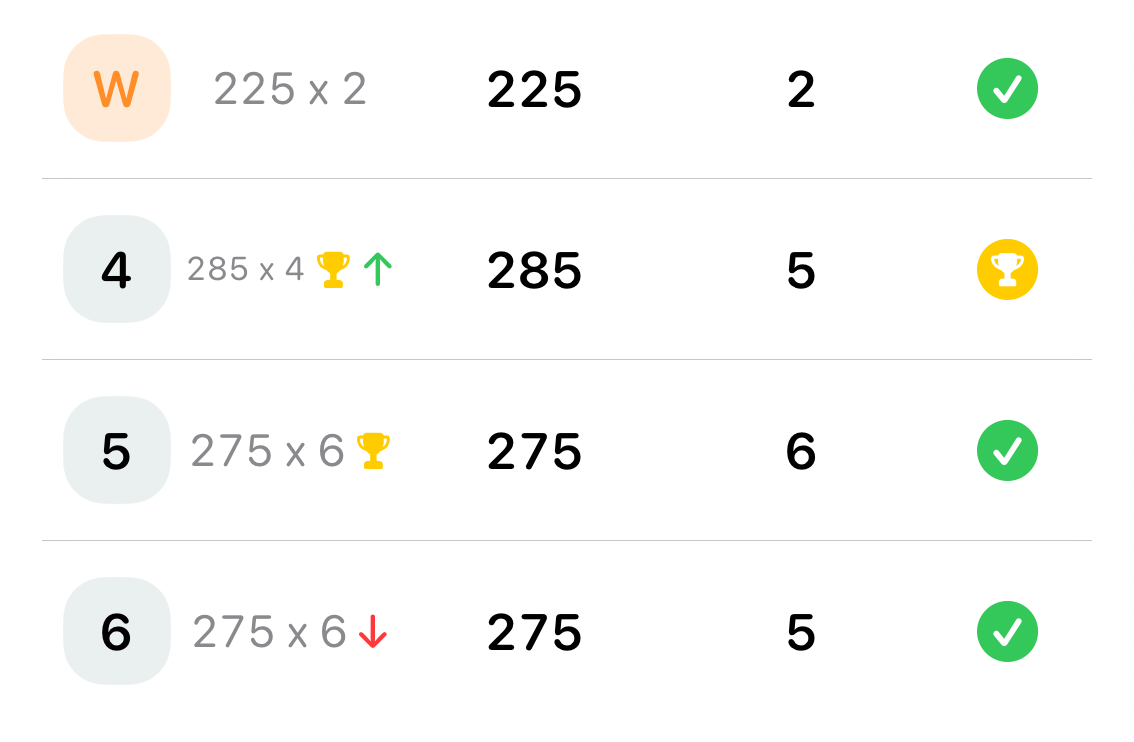
- Each set planned in your routine shows what you did the last time you completed that set. There is no time limit on “last time”, so in your first workout after 10 weeks away you see your sets from before the break. History keeps every earlier workout too, so you can open the last one before the break and compare it with today’s.
- When you log a set, a green up arrow or a red down arrow shows whether it beat that earlier set. For standard weight-and-reps exercises such as the leg press, the arrow compares estimated 1RM and ignores changes under 0.5%. Take the leg press log above, with the best set as the same set of the routine each week. Week 1 gets a red arrow, because it is compared with the pre-break set. Week 2 gets a green arrow, because it is compared with week 1. A red arrow can mean a drop as small as 0.5%, well inside the 3.1% test-to-test variation in the Finnish study.
- Personal records are judged against your whole history. A record for heaviest weight or estimated 1RM after a break means you have beaten your best from before it. If 200 lb for 5 was the lifter’s best, those records would come in week 5 of that log. The app also tracks the most reps at each exact weight, and that kind of record can come sooner.
The app does not suggest a weight for your return. A page for each exercise, with a chart of estimated 1RM over time and a list of all-time records, is part of SetGrip Premium.
Once you are back to your old numbers, How to Track Progressive Overload in a Workout Log covers how to compare workouts from there. You can download SetGrip on the App Store.
When to talk to someone
- According to the CDC, these can be symptoms of a heart attack: chest pain or discomfort; feeling weak, light-headed or faint; shortness of breath. In the US, call 911 right away. Elsewhere, call your local emergency number.
- The American College of Sports Medicine’s screening guidance looks at three things: how active you are now; signs, symptoms or a diagnosis of heart, metabolic or kidney disease; and how hard you plan to train (Riebe et al., 2015). Diabetes is one example of a metabolic disease. If you have one of those conditions or symptoms, talk to your doctor before you start training again.
- If your break was caused by an injury, surgery or illness, ask the doctor or physical therapist who treated you when and how to return.
- If you are pregnant or recently gave birth, ask the doctor or midwife caring for you. The American College of Obstetricians and Gynecologists (2020) says physical activity in pregnancy is safe and desirable when there are no obstetric or medical complications or contraindications (medical reasons not to exercise). It adds that some changes to exercise routines may be needed.
- If pain does not settle after you return to training, a doctor or physical therapist can assess it.
This article describes what studies measured and how to compare numbers in a training log. It is not a training plan or medical advice.
Sources
- Halonen EJ, Gabriel I, Kelahaara MM, Ahtiainen JP, Hulmi JJ. Does Taking a Break Matter—Adaptations in Muscle Strength and Size Between Continuous and Periodic Resistance Training. Scandinavian Journal of Medicine & Science in Sports. 2024;34(10):e14739.
- Coleman M, Burke R, Augustin F, et al. Gaining more from doing less? The effects of a one-week deload period during supervised resistance training on muscular adaptations. PeerJ. 2024;12:e16777.
- Ogasawara R, Yasuda T, Ishii N, Abe T. Comparison of muscle hypertrophy following 6-month of continuous and periodic strength training. European Journal of Applied Physiology. 2013;113(4):975–985.
- McMaster DT, Gill N, Cronin J, McGuigan M. The development, retention and decay rates of strength and power in elite rugby union, rugby league and American football: a systematic review. Sports Medicine. 2013;43(5):367–384.
- Bosquet L, Berryman N, Dupuy O, et al. Effect of training cessation on muscular performance: a meta-analysis. Scandinavian Journal of Medicine & Science in Sports. 2013;23(3):e140–e149.
- Lemmer JT, Hurlbut DE, Martel GF, et al. Age and gender responses to strength training and detraining. Medicine & Science in Sports & Exercise. 2000;32(8):1505–1512.
- Psilander N, Eftestøl E, Cumming KT, et al. Effects of training, detraining, and retraining on strength, hypertrophy, and myonuclear number in human skeletal muscle. Journal of Applied Physiology. 2019;126(6):1636–1645.
- Staron RS, Leonardi MJ, Karapondo DL, et al. Strength and skeletal muscle adaptations in heavy-resistance-trained women after detraining and retraining. Journal of Applied Physiology. 1991;70(2):631–640.
- Cumming KT, Reitzner SM, Hanslien M, et al. Muscle memory in humans: evidence for myonuclear permanence and long-term transcriptional regulation after strength training. The Journal of Physiology. 2024;602(17):4171–4193.
- Spiering BA, Mujika I, Sharp MA, Foulis SA. Maintaining Physical Performance: The Minimal Dose of Exercise Needed to Preserve Endurance and Strength Over Time. Journal of Strength and Conditioning Research. 2021;35(5):1449–1458.
- Riebe D, Franklin BA, Thompson PD, et al. Updating ACSM's Recommendations for Exercise Preparticipation Health Screening. Medicine & Science in Sports & Exercise. 2015;47(11):2473–2479.
- American College of Obstetricians and Gynecologists. Physical Activity and Exercise During Pregnancy and the Postpartum Period: ACOG Committee Opinion No. 804. Obstetrics & Gynecology. 2020;135(4):e178–e188.
- Centers for Disease Control and Prevention. About Heart Attack Symptoms, Risk, and Recovery. 2024.
Sources checked on November 21, 2026. We checked every number in this article in the study itself or in its published summary.