Short answer: to track progressive overload, log every working set with the exercise, weight and reps, then compare each exercise with its own earlier sessions. You are progressing if, over several weeks, you lift more weight for the same reps, do more reps at the same weight, or do more sets at the same weight and reps.
Judge the trend, not one workout. Even a tested one-rep max (1RM) varies, with a median coefficient of variation of 4.2% across 32 studies (Grgic et al., 2020). In our fictional eight-session log, a 5 lb jump cuts session volume by 20.5% and estimated 1RM by 1.5%, yet the lifter is still progressing.
Progressive overload “refers to the need to increase the stimulus (stressor) placed upon the muscle throughout a training program”, in the words of the American College of Sports Medicine (ACSM). Its 2026 position stand, a formal review of the evidence, names load, volume, training frequency, exercise selection and duration as ways to do that, “even if only slightly”.
We checked each quote and figure in this article in the paper or its published abstract. The bench press example is fictional and its numbers are calculated. The facts about SetGrip, a workout tracker for iPhone and Apple Watch, come from its code.
What should you log to track progressive overload?
Log three things for each working set: the exercise, the weight and the reps. Two more help if you can add them: how hard the set felt, and anything that changed.
- The exact exercise. A paused bench press and a touch-and-go bench press are different lifts in a log.
- Weight and reps for each set. “3 × 8” hides a last set that fell to 6.
- Effort, if you want it. A common measure is reps in reserve (RIR), the reps you could still have done. The ACSM’s 2026 stand mentions a target of 2–3 RIR, and also says there is “insufficient evidence to quantify exact RIR and perceived exertion targets”. So treat any RIR number as a rough guide.
- Anything that changed. A new machine, a shorter rest or a different exercise order can move the numbers without any change in you.
Keep warm-up sets out of the comparison.
How do you compare sessions fairly?
Compare a set only with an earlier set of the same exercise that shares the weight or the reps. When one number stays the same and the other goes up, the progress is clear:
- Same reps, more weight: 135 lb × 8, then 140 lb × 8.
- Same weight, more reps: 135 lb × 8, then 135 lb × 9.
- Same weight and reps, more sets: 3 sets of 135 lb × 8, then 4 sets.
- Same numbers, less effort: 135 lb × 8 with two reps left instead of one, if you log effort.
If the weight went up and the reps went down, there is no direct match. Is 140 lb × 7 better than 135 lb × 8? Estimated 1RM, a formula that turns weight and reps into one number, gives a rough answer. With the Epley formula, weight × (1 + reps ÷ 30), 140 lb × 7 comes to 172.7 lb and 135 lb × 8 to 171.0 lb. That 1% gap is small, so treat the two sets as about equal and see what the next sessions do.
Which number shows progress best?
A heavier top set at the same reps is the plainest sign of progress, and estimated 1RM helps when weight and reps both change. No single number is enough, because each one misleads in a different situation.
| Number | What it is | Helps with | Misleads when |
|---|---|---|---|
| Top set | Weight × reps of your best working set | A quick check against last time | The weight rose and the reps fell |
| Reps at a fixed weight | Total reps at the same weight | Weeks when the weight does not change | Rest or effort changed |
| Estimated 1RM | A formula applied to weight and reps | Comparing sets with different weights and reps | You read it as your true max, or use it for sets above 10 reps |
| Session volume | Weight × reps, added up across all sets of one exercise | Total work over several weeks | You add weight and reps fall, or add easy sets |
Estimated 1RM is a rough figure. Our article Are 1RM Calculators Accurate? covers how far off it can be. Session volume is also less tested than it looks. The ACSM’s 2026 stand links more weekly sets to more muscle growth, but notes that weekly volume load, the total of weight × reps × sets, “was rarely considered” in the reviews it examined.
A worked example: eight bench press sessions
This fictional bench press log shows why estimated 1RM and volume can both fall right after a weight increase, even when the lifter is getting stronger. The lifter does three sets with a target of 8 reps, two sessions a week, adds reps first and adds 5 lb after reaching 10 reps on all three sets. Estimated 1RM uses the best set of the day and the Epley formula.
| # | Sets (lb × reps) | Est. 1RM (lb) | Volume (lb) |
|---|---|---|---|
| 1 | 135 × 8, 8, 8 | 171.0 | 3,240 |
| 2 | 135 × 9, 8, 8 | 175.5 | 3,375 |
| 3 | 135 × 10, 9, 8 | 180.0 | 3,645 |
| 4 | 135 × 10, 10, 9 | 180.0 | 3,915 |
| 5 | 135 × 10, 10, 10 | 180.0 | 4,050 |
| 6 | 140 × 8, 8, 7 | 177.3 | 3,220 |
| 7 | 140 × 9, 8, 8 | 182.0 | 3,500 |
| 8 | 140 × 10, 9, 8 | 186.7 | 3,780 |
What the fictional log shows:
- Sessions 1 to 5 of the log are clear progress. The weight stayed at 135 lb and total reps rose from 24 to 30, so session volume rose 25%. Estimated 1RM stopped at 180.0 lb after session 3, because it reads only the best set. It missed the reps added to the second and third sets in sessions 4 and 5.
- Session 6 of the log is not a step back. After the 5 lb jump, estimated 1RM fell 1.5% (180.0 to 177.3 lb) and session volume fell 20.5% (4,050 to 3,220 lb) from session 5. Compared like with like, 140 lb × 8 beats the 135 lb × 8 of session 1: same reps, more weight.
- Estimated 1RM and volume recover at different speeds. In the log, estimated 1RM reached a new high of 182.0 lb by session 7. At session 8 volume was still 3,780 lb, below the 4,050 lb of session 5, even though session 8 repeats the reps of session 3 (10, 9, 8) with 5 lb more on the bar.
Should you add reps or weight first?
Adding reps and adding weight can both work, and one 8-week trial found little difference between them. In the 2022 trial by Plotkin et al., 43 resistance-trained adults enrolled and 38 finished. They did four sets of four lower-body exercises twice a week. One group aimed to add load and the other to add reps at the same load. The authors concluded that both are “viable strategies”.
In Plotkin et al., gains in Smith machine squat 1RM slightly favored the load group, by 2.0 kg, and growth of the rectus femoris, a thigh muscle, modestly favored the reps group, by 2.8 mm summed across measurement sites. In both cases the data were also compatible with no difference, and the range for strength was wide, from −2.4 to 7.8 kg. The trial covered only the lower body, trained adults aged 18 to 35, sets taken to failure and eight weeks.
Adding reps and adding weight can also be combined: add reps until you pass your target, then add weight. The ACSM’s 2009 position stand advised a 2–10% load increase when you can do “one to two repetitions over the desired number”. The 2026 stand, which updates it, does not repeat that figure, so treat it as an older rule of thumb. The fictional bench press log follows it. The 5 lb jump from 135 lb is 3.7%, inside that range. The same 5 lb jump on a 25 lb dumbbell is 20%, which is why adding reps is often the practical choice for small lifts.
How often should the numbers go up?
The sources we checked give no schedule for adding weight or reps. The ACSM’s 2026 stand states no rate of progress, and its 2009 stand tied a 2–10% load increase to extra reps rather than a date. A simple habit is to check last time’s set before you lift, then compare each main lift with the same lift three to four weeks earlier. That is our suggestion, not a research finding.
One session with lower numbers means little. In a 2020 systematic review of 32 studies of repeat 1RM tests (Grgic et al.), the median coefficient of variation, a measure of how much results differ between tests, was 4.2%, ranging from 0.5% to 12.1%. If a controlled test varies that much, a dip of 1 or 2% in a training set may be normal too.
When does a flat stretch count as a plateau?
We found no standard definition of a strength plateau in the sources for this article, so any rule is a judgment call. The stall alert in SetGrip Premium uses one of its own, which is a product choice and not a research finding. In SetGrip, an exercise counts as stalled when all of these are true:
- it has at least 5 training days with a set of 10 reps or fewer;
- you trained it in the last 21 days;
- its best estimated 1RM has not been beaten by more than 2.5% for at least 3 training days;
- at least 21 days have passed since that best.
The fictional bench press log never meets SetGrip’s stall rule. Its 180.0 lb best from session 3 was not beaten by more than 2.5% for four more sessions, but those sessions took only 14 days, short of the 21 the rule needs. Session 7 reached 182.0 lb, just 1.1% higher, too little to count, and session 8 broke through at 186.7 lb, 3.7% higher.
Do you always need progressive overload?
The ACSM recommends progressive overload, but does not treat it as essential for every goal. The conclusion of its 2026 stand is that “Healthy adults should perform progressive RT”, meaning resistance training. Its discussion adds that “progression is not necessary to achieve beneficial outcomes”, and that increasing the stimulus is “likely a requirement only for those seeking continued longer term progress”. It also says continued progression “could be a personal decision”.
The ACSM’s 2026 stand singles out people who must start with low loads, because of inexperience or safety concerns: for them, progression “is a requirement to achieve a meaningful benefit”. For others, a flat log matters mainly if your goal is to keep getting stronger or bigger.
Should you use a notebook, a spreadsheet or an app?
A notebook, a spreadsheet and an app all work if you look at your last numbers before you lift. They differ in how much of the comparison you do by hand.
- Notebook: free and quick to fill in. You flip back to find last time’s numbers and do any math yourself.
- Spreadsheet: one row per set, with columns for date, exercise, weight and reps. With weight in column C and reps in column D,
=C2*D2gives set volume and=C2*(1+D2/30)gives the Epley estimate. Filter by exercise to see the trend. - Workout app: shows last time’s numbers next to the set you are about to do and works out records for you. Before you commit, check whether it exports your data and whether its charts are free.
How SetGrip tracks progressive overload
SetGrip, a workout tracker for iPhone and Apple Watch, compares each planned set you log with the same set from last time, while you train. In the current version, 1.1.6, the free app gives you:
- Last time’s set. In SetGrip, each set planned in your routine shows what you did in that set position the last time you completed it, so you can see what to beat. Sets and exercises you add mid-workout on iPhone show no previous result and no arrow. A trophy marks a previous set that was a personal record.
- Arrows. When you log a set in SetGrip, a green or red arrow shows whether it beat the same set last time. For weight and reps, the arrow compares estimated 1RM and ignores changes under 0.5%. So all three 140 lb sets in session 6 of the fictional bench press log would show a down arrow, even though the weight went up. One of them would still earn a Weight Record, so the trophy shows what the arrow misses.
- Records. SetGrip detects eight kinds of personal record, including estimated 1RM, most reps at a weight, best set volume and best session volume. You see them in the workout and its summary.
- Warm-ups. Sets marked Warm Up in SetGrip stay out of the Statistics tab and records. The Volume figure on the workout screen and in History still counts them.
- Export. SetGrip’s CSV export has one row per set, with weight in column G and reps in column H, so
=G2*H2gives set volume and=G2*(1+H2/30)gives the Epley estimate. That estimate matches SetGrip for 6 to 10 reps. At 5 reps or fewer SetGrip uses the Brzycki formula, so its estimate is lower, and above 10 reps it gives none. The file also includes warm-ups and sets you did not complete, so filter by column F (set type) and column K (completed) first.
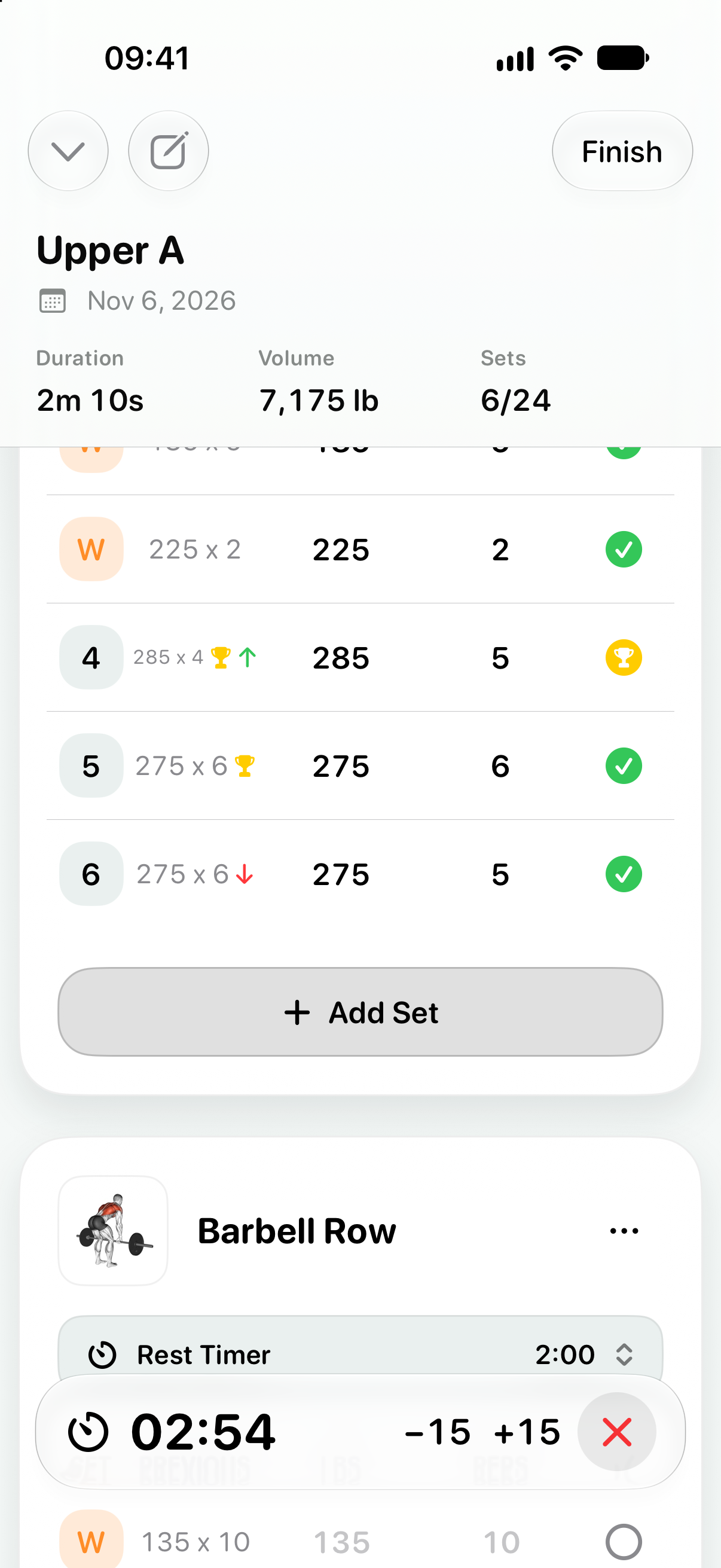
SetGrip Premium adds a page for each exercise, with a chart of estimated 1RM, heaviest weight, best set volume, session volume or total reps, plus all-time records. It also adds stall alerts, as a card in Statistics and as a notification.
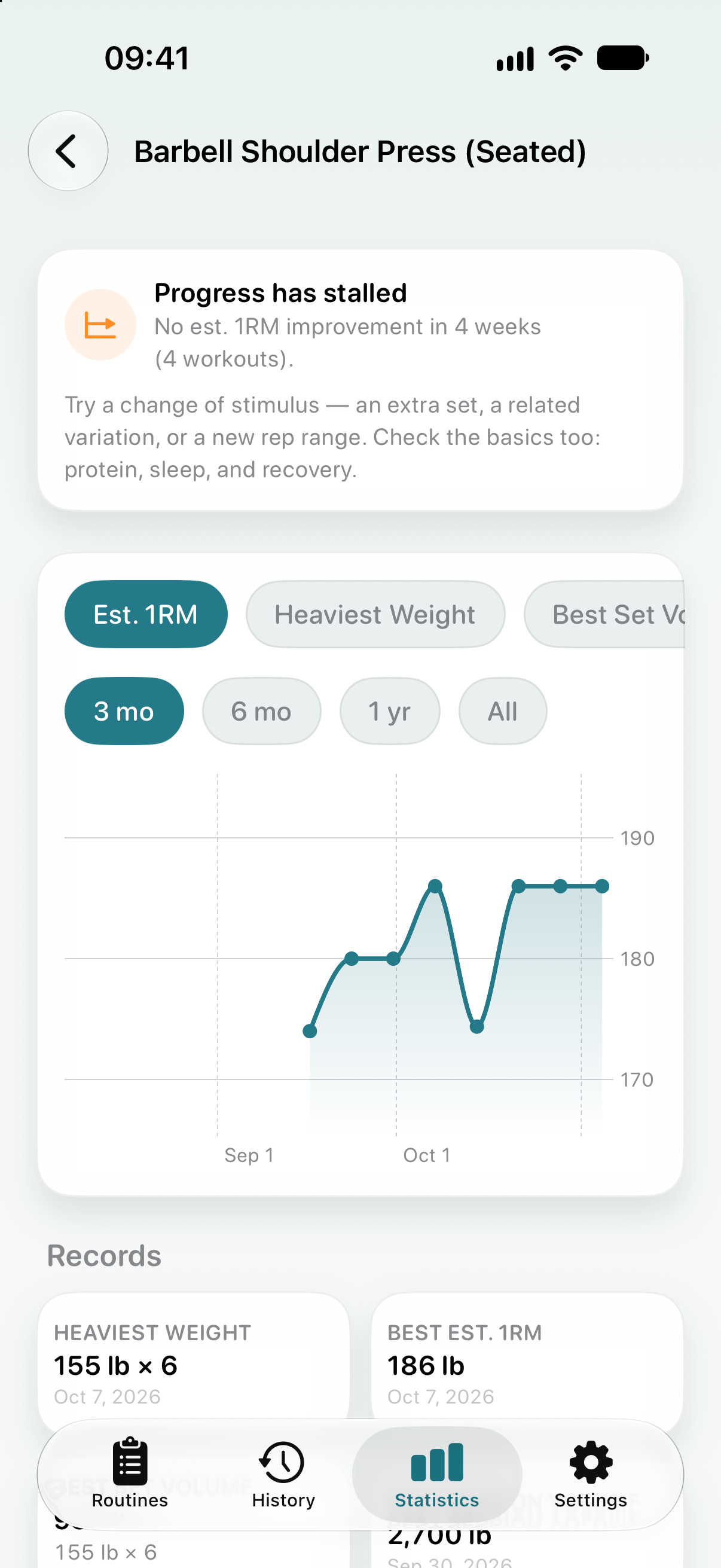
The stall card offers general ideas, such as an extra set or a new rep range, but SetGrip does not suggest your next weight. It also has no field for reps in reserve, so if you track effort, keep it in Workout Notes, one free-text note per workout.
The help article What is free in SetGrip and what does Premium add? has the full list of free and Premium features, and Export your SetGrip workout history lists the CSV columns. SetGrip is free to download on the App Store.
When to talk to someone
- Chest discomfort, feeling faint or lightheaded, or trouble breathing during or after exercise can be signs of a heart attack, according to the CDC. In the US, call 911 right away; elsewhere, call your local emergency number.
- Heart, metabolic or kidney disease, or symptoms of them: talk to your doctor before you start or step up training (ACSM screening guidance, Riebe et al., 2015).
- Pregnant: ask your obstetric care provider which exercise suits you (ACOG, 2020).
- Pain or an injury that has not settled: a doctor or physical therapist can assess it. A stalled number is not a reason to lift through pain.
This article explains how to log and compare training numbers. It is not a training plan or medical advice.
Sources
- Currier BS, D'Souza AC, Fiatarone Singh MA, et al. American College of Sports Medicine Position Stand. Resistance Training Prescription for Muscle Function, Hypertrophy, and Physical Performance in Healthy Adults: An Overview of Reviews. Medicine & Science in Sports & Exercise. 2026;58(4):851–872.
- American College of Sports Medicine. American College of Sports Medicine position stand. Progression models in resistance training for healthy adults. Medicine & Science in Sports & Exercise. 2009;41(3):687–708.
- Plotkin D, Coleman M, Van Every D, et al. Progressive overload without progressing load? The effects of load or repetition progression on muscular adaptations. PeerJ. 2022;10:e14142.
- Grgic J, Lazinica B, Schoenfeld BJ, Pedisic Z. Test–Retest Reliability of the One-Repetition Maximum (1RM) Strength Assessment: a Systematic Review. Sports Medicine – Open. 2020;6(1):31.
- Riebe D, Franklin BA, Thompson PD, et al. Updating ACSM's Recommendations for Exercise Preparticipation Health Screening. Medicine & Science in Sports & Exercise. 2015;47(11):2473–2479.
- American College of Obstetricians and Gynecologists. Physical Activity and Exercise During Pregnancy and the Postpartum Period: ACOG Committee Opinion No. 804. Obstetrics & Gynecology. 2020;135(4):e178–e188.
- Centers for Disease Control and Prevention. About Heart Attack Symptoms, Risk, and Recovery. 2024.
Sources checked on November 6, 2026.